
AI Adoption Is Moving Fast: How and where can we protect necessary human judgement?
AI is no longer sitting at the edge of organisational life. It is moving into workflows, decisions, client delivery, knowledge management and leadership conversations. As organisations accelerate AI deployment, the question is no longer simply whether people are using AI, but, along with the acceleration in processes, how do we instil cognitive protection frameworks?
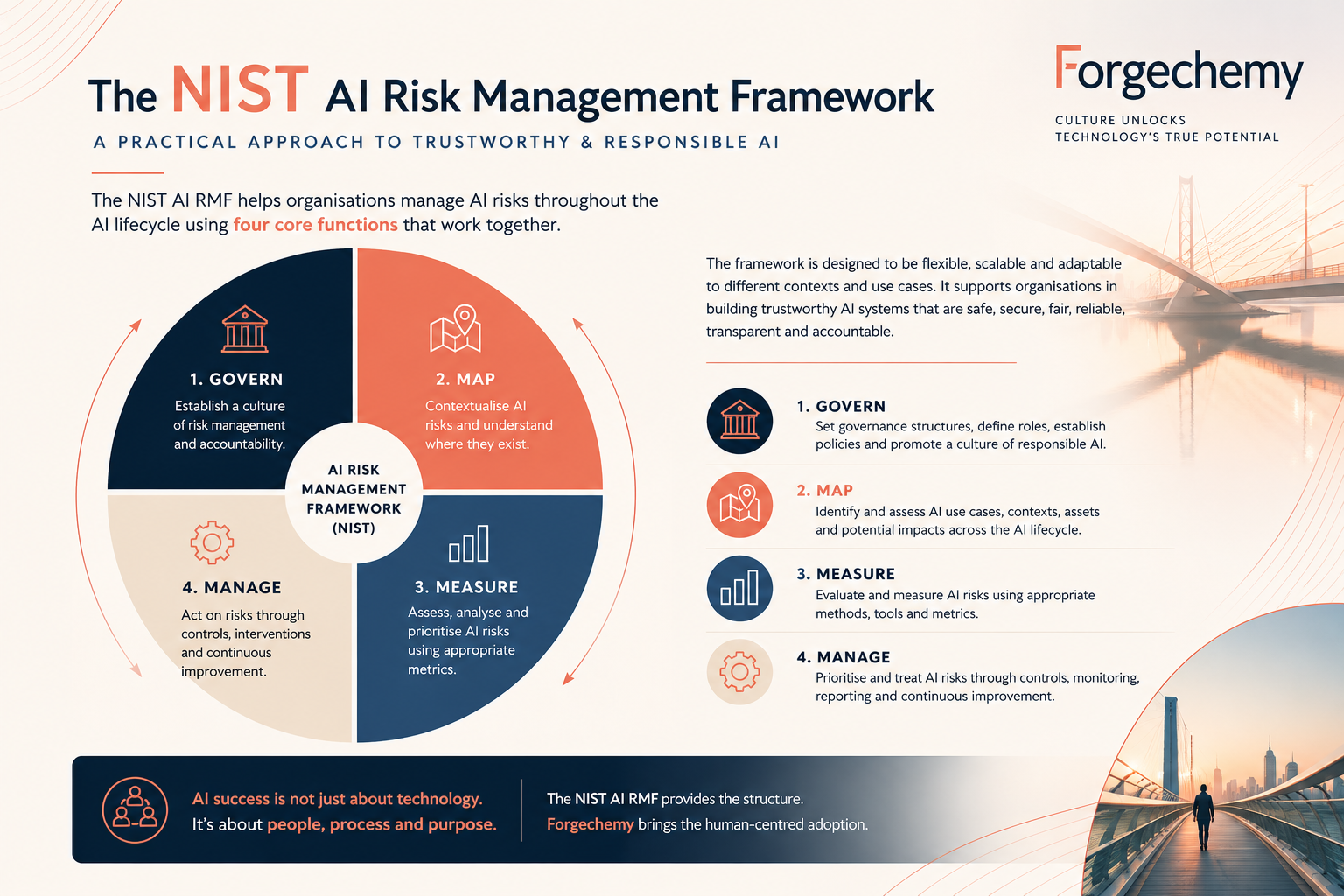
The National Institute of Standards and Technology (NIST), part of the U.S. Department of Commerce, developed the Artificial Intelligence Risk Management Framework (AI RMF 1.0) as voluntary guidance to help organisations manage AI risks across the AI system lifecycle. The framework is structured around four core functions: Govern, Map, Measure and Manage. NIST describes the AI RMF as a way to help organisations incorporate trustworthiness considerations into the design, development, use and evaluation of AI systems.
For me, the value of the NIST AI RMF is that it gives organisations a credible and practical risk-management structure. But there is another layer that needs equal attention: the human and behavioural layer. AI risk is not just technical; it is cultural, cognitive and operational. It sits in the way of people using tools, trusting outputs, challenging assumptions, escalating concerns, and taking responsibility for decisions.
The hidden risk is not AI. It is blind automation.
The problem is not that people use AI. but that they may stop noticing when they have stopped thinking. We all get carried away and seduced by fluent, polished output. The lack of friction means that we lose our ability to think and follow the path of least resistance.
People are more likely to accept an answer when it looks complete, polished and authoritative. Over time, this can also lead to automation deference, where employees assume the system has “seen more” and therefore must be right.
For experienced professionals, AI can be a powerful accelerator. They already have the judgement to challenge, adapt and contextualise outputs. But for junior employees, the risk is different. If AI removes too many of the difficult cognitive steps, it can weaken the apprenticeship layer where professional judgement is formed.
People learn the thinking patterns required for their role by: Research, drafting, comparison, first-principles thinking, error correction, and challenge.
If organisations automate those steps too early, they may gain short-term productivity while weakening long-term capability.
Let’s be practical
The legal cost of weak judgement
The legal risk is not simply that AI might produce a poor output. The deeper risk is that the organisation cannot explain how a decision was made.
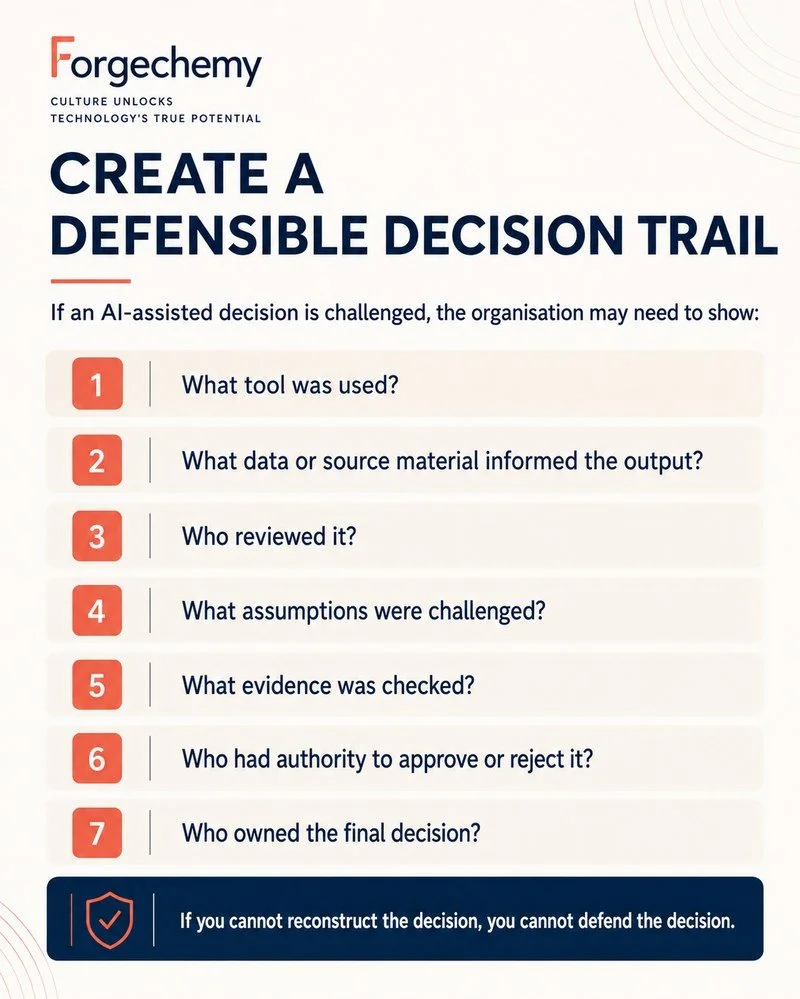
This matters in hiring, HR, procurement, legal, financial services, healthcare, engineering, public sector delivery, safety-critical environments and any context where decisions affect people, money, reputation or regulatory obligations.
A human-in-the-loop process is not enough if the human is rushed, undertrained, unclear on accountability or reluctant to challenge the machine.
A person clicking “approve” is not meaningful oversight. A person who can interrogate the output, challenge its assumptions and take responsibility for the final decision is meaningful oversight.
The operational cost of blind automation
Poorly governed AI can create the appearance of productivity while increasing rework, error propagation and dependency. Teams may move faster at task level but slower at decision level because no one is sure what can be trusted.
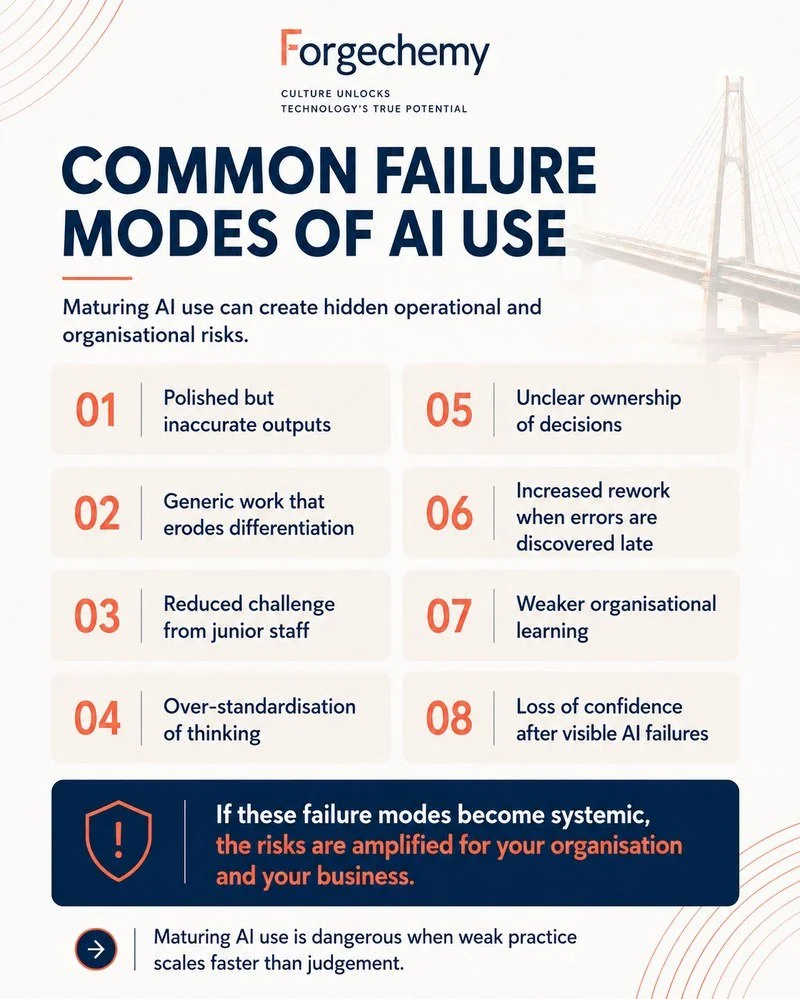
From AI governance to cognitive governance
This is where organisations need to go beyond policy documents and tool access.
1. AI governance asks: is the system safe, compliant and controlled?
2. Cognitive governance asks: are humans still thinking clearly, challenging appropriately and owning decisions?
This is where Forgechemy’s work sits: at the intersection of AI adoption, organisational behaviour and human judgement. Technology can create momentum, but culture determines whether that momentum becomes value or risk.
Adoption asks: “How do we get people to use AI?”
Acumen asks: “How do we help people use AI in ways that improve judgement, preserve accountability and strengthen organisational capability?”
The Forgechemy Cognitive Preservation Framework
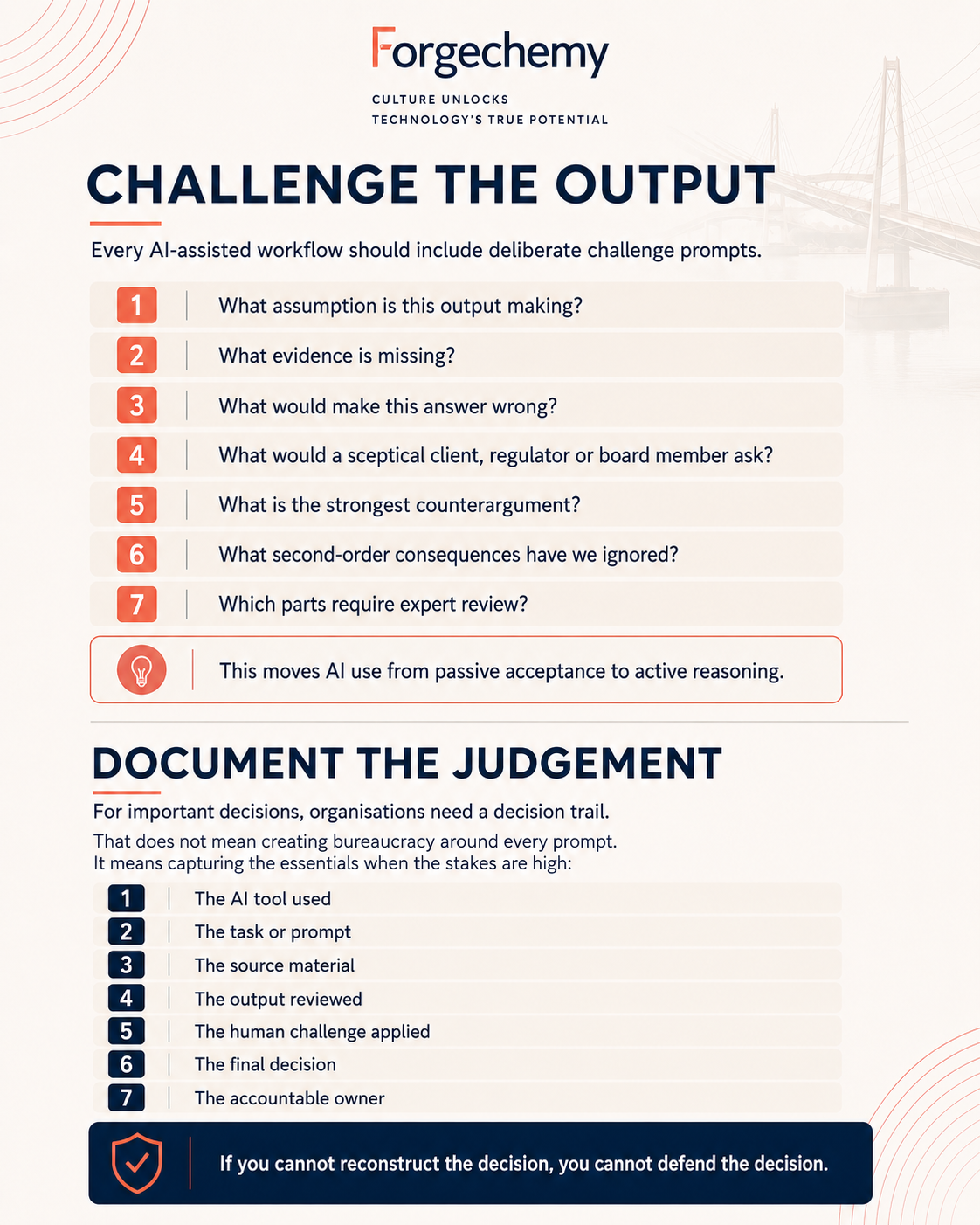
To make AI adoption sustainable, organisations need practical cognitive safeguards designed into the way work happens. This is not about slowing AI down but about applying friction in the right places.
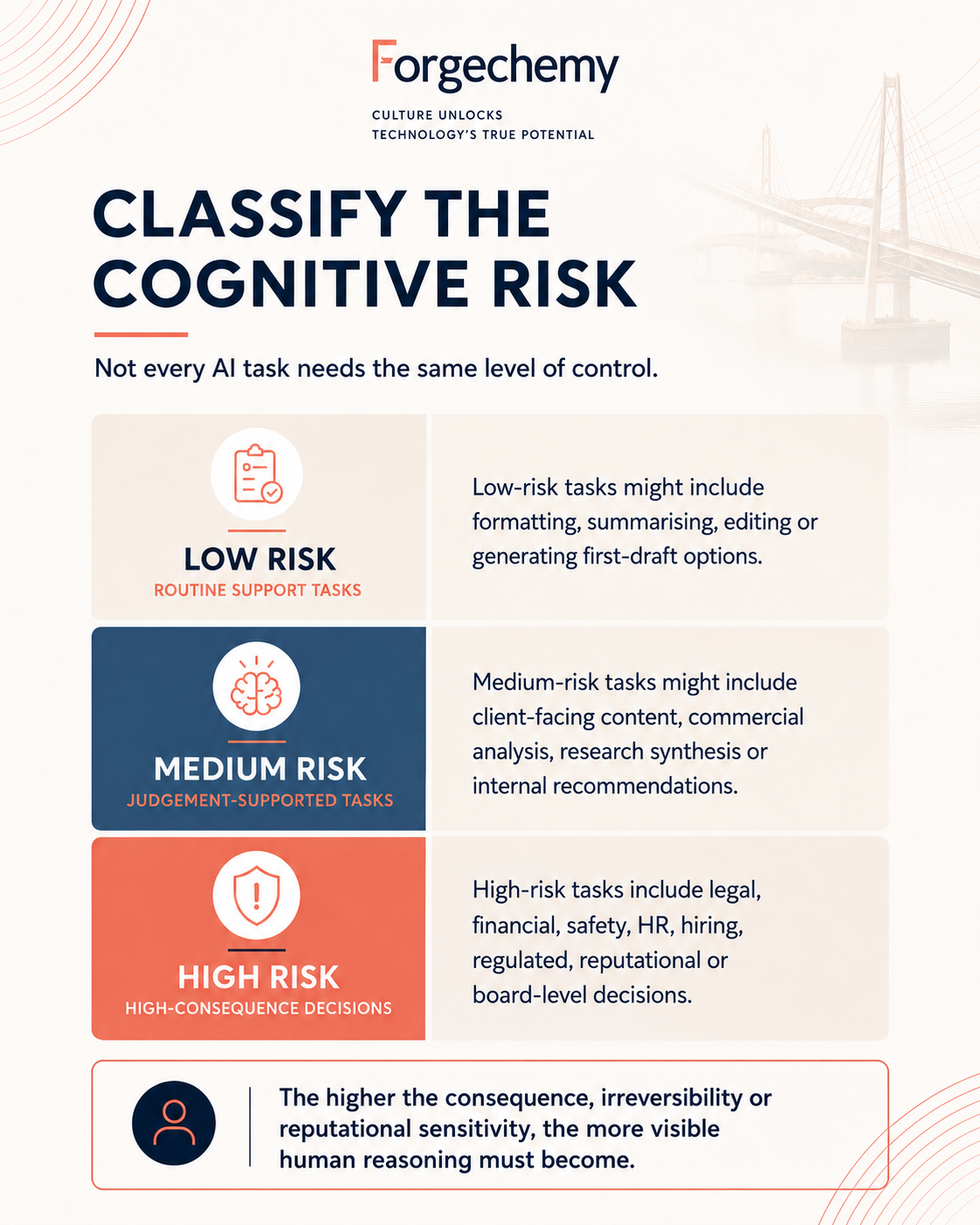
Frame before AI
I believe that the most important safeguard is deceptively simple: humans should frame the problem properly before AI generates the answer.
Before using AI, a great rule of thumb is the user should define:
What problem they are solving?
What a good answer would need to include?
What assumptions they are making?
What constraints matter?
What evidence would change the recommendation?
AI should enter after the human has formed an initial mental model, not before. This protects reasoning from being shaped too early by a confident machine-generated answer.
Measure quality, not just usage
Many AI programmes over-focus on adoption metrics: number of users, number of prompts, time saved and documents generated.
Those are useful, but they are not enough.
Better measures include:
• error rates
• rework rates
• escalation behaviour
• quality of outputs
• decision outcomes
• confidence calibration
• challenge frequency
• audit findings
• client feedback
• junior capability development
• psychological safety to question AI outputs
The goal is not maximum AI usage. The goal is better work, better decisions and better organisational learning.
The right friction in the right place
The answer is not to slow AI adoption down. Organisations are right to move quickly and there are significant opportunities to improve business processes and, the dreaded word, efficiencies. But speed without cognitive preservation frameworks leave you exposed.
The next competitive advantage will come from organisations that can combine speed with scrutiny, automation with accountability, and AI capability with human wisdom.
Source: This article references the National Institute of Standards and Technology (NIST), Artificial Intelligence Risk Management Framework (AI RMF 1.0), NIST AI 100-1. Forgechemy is not affiliated with or endorsed by NIST.